Our experience at the 2026 Green Schools Conference
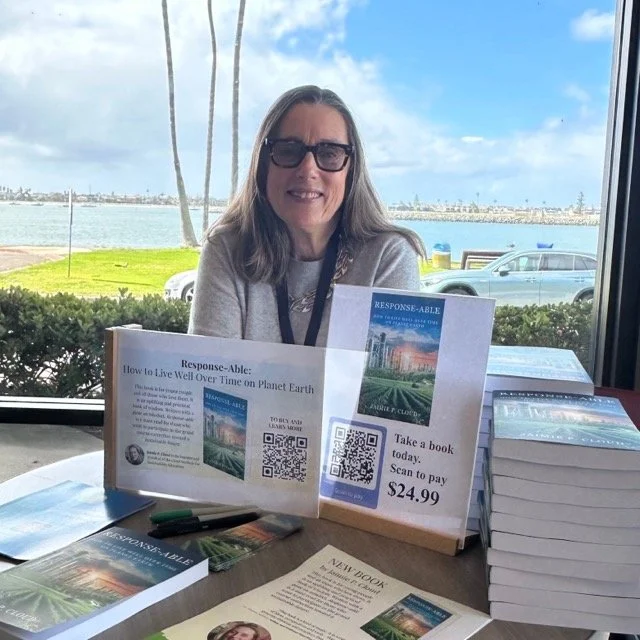
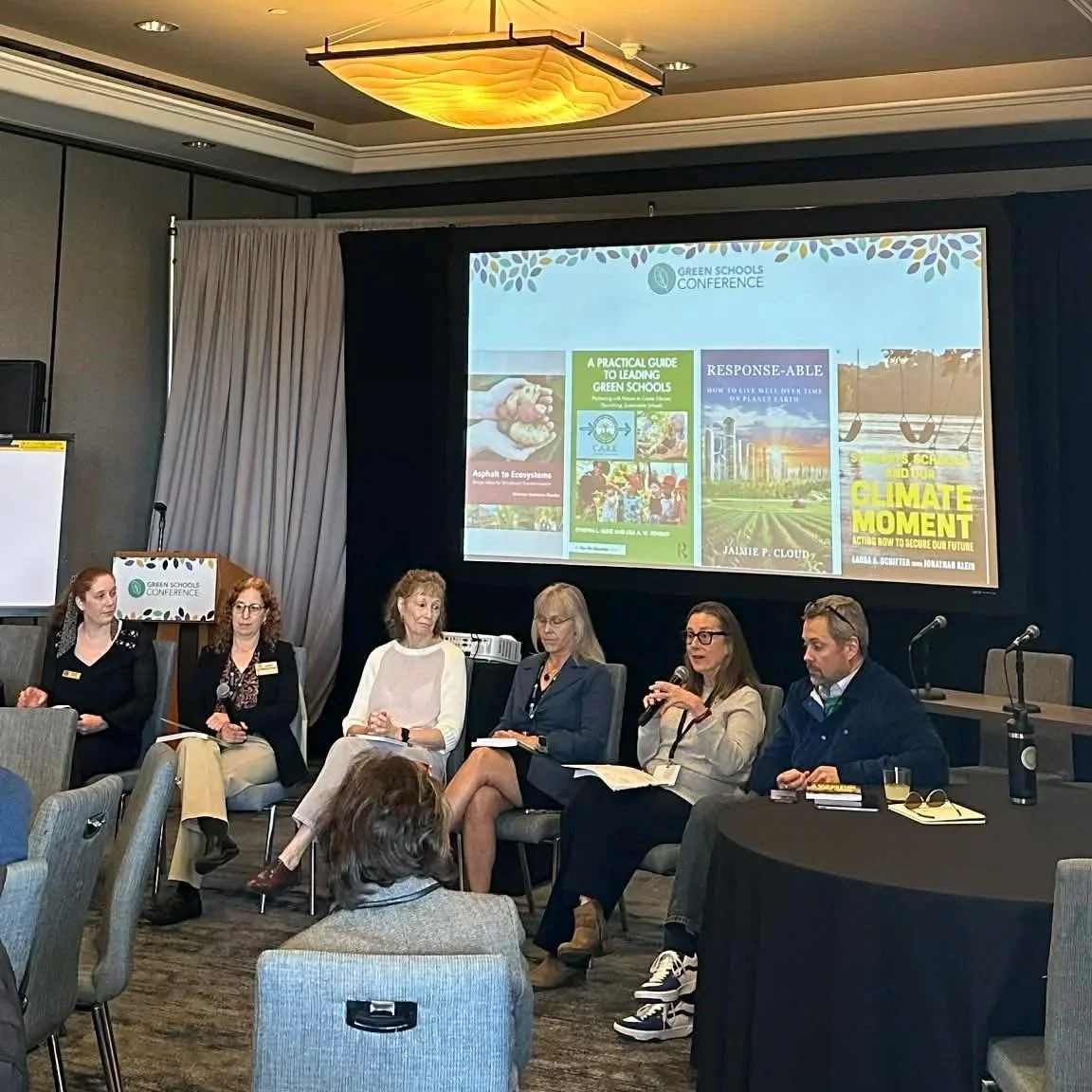
We enjoyed attending the Green Schools Conference in San Diego last month. It was a pleasure to reconnect with--and meet new members of this community.
Our favorite parts were the Green Book Zone, and the open plenary, with Cody Petterson, board member of the San Diego Unified Public School District, delivering a powerful keynote and of course.
It was great to see Jaimie share her book, Response-Able, and to watch it find its way into meaningful conversations with students, teachers, nonprofit leaders, school administrators from many places.
We were very inspired by Cody’s speech, so we asked for a copy to share it here, so it can inspire you too:
Thank you, Superintendent Harris. Good morning to all of you.
I’m Cody Petterson and I’m proud to serve on the San Diego Unified and to the national Green Schools Conference.
It is an honour for our city and our district to host you this week.
We hope you find us in kindred spirits and champions of our shared values.
Across the spectrum of green policies, our district has aspired to regional, state, and national leadership. We are blessed by the best Facilities Planning and Construction team in the business, led by Lee Dulgeroff.
We are in the final stages of delivering one of the largest school-based solar programs in the country. By the end of this year, San Diego Unified will have installed photovoltaic systems at 132 schools and facilities, totaling 39 megawatts of capacity. We will generate more than 62 million kilowatt-hours of clean electricity annually, covering over 60 percent of the District’s total energy use and avoiding roughly 20,000 tons of greenhouse gas emissions each year.
We are piloting battery energy storage systems across multiple sites, reducing reliance on fossil-fuel peaker plants, reducing strain on the power grid, and lowering greenhouse gas emissions.
We are the first district in the region to mandate 100% all-electric on all new construction and end of life replacements. All of our bond investments are all-electric moving forward.
We are also investing in electrifying our fleet of school buses and other district vehicules and installing electric vehicule charging infrastructure at our schools.
You will hear on Thursday about San Diego Unified’s partnership with the Ocean Discovery Institute on their LEED Platinium Living Lab and California’s first LEED Platinium public school, Montgomery Middle.
We’ve also invested $350 million dollars in replacing and retrofitting HVAC systems throughout the district.
We’re working to improve our vast food system, which serves tens of thousands of students everyday. We’re investing in scratch kitchens, farm to school, harvest of the month, and food waste reduction and diversion. Through our Love Food Not Waste program, our leftover prepared food is distributed in collaboration with Feeding San Diego to local relief organizations, rescuing 600,000 pounds of food since its inception.
We’re working to integrate school gardens and orchards into our Whole Site Modernizations, as well as nature-based play area and structures and increased tree canopy.
We’re working on restoring our field education program. Draconian budget cuts in the 2000s forced us to close the district’s historic Camp Palomar, which hosted San Diego Unified students for a weeklong sixth grade camp for a half century. Including myself.
San Diego is dominated by our canyon-mesa topography and we’re exploring ways to foster canyon-campus connectivity.
San Diego is also the most biodiverse county in the continental United States and we’re eager to expand our native plant landscaping to help preserve our biodiversity and integrate it into our curriculum and instruction.
Finally, we have the most ambitious Education Workforce Housing program in the country, having approved nearly 3,000 units of affordable employee housing. Two-thirds our our GHG emissions come from student and staff transportation, and we are committed to welcoming teachers back into the communities they serve and dramatically reducing commute times and emissions.
But I want to wrap up this morning by asking all of you to reflect on why we do all of this sustainability work. Why?
I happen to have come out of the environmental movement: Sierra Club, California Native Plant Society, Senior Advisor for Land Use and Environment for our County Supervisor. I teach a course called “Politics for Environmental Change” in the UCSD Anthro department, where I did my PhD.
I am personally a hardcore environmentalist. I imagine the same applies to many of you. But is that why we do this? Do we have an environmental ideology that we want to impose on our children?
Are we just woke?
I’ll tell you why we do this work. I’m here to [stop] everything that makes our children scared, and isolated, and detached, and neglected, and impoverished, and unequal, and ashamed of themselves—of their race, of their language, of their gender, of their sexuality—and everything that leaves our children starved for purpose, starved for nature, starved for connection, belonging, mattering, meaning, starved for a sense of place, a sense of the part they were made to play in the whole.
If we thought that it was good for children to play on asphalt and DG, we would invest in that, rather than solar shade structures and school gardens.
If we thought it was beneficial for children to spend their time in front of screens, rather than with teachers and friends and books and projects, then we would plug them into the matrix.
If we thought it was best for our children to destroy the planet they will inherit, we would continue to power our schools with fossil fuels.
We commit to sustainability because we love all our children and we are committed to ensuring that they inherit a world that can sustain life.
Every morning, parents deliver 95,000 children into our care. Our Board and our 14,000 employees serve in lovo parentis –in place of a parent—and everything we do is to love and protect and nurture their children as they would.
Our ancestors spent 4 billion years as part of the natural world.
We did not evolve to sit in front of screens. We did not evolve to live and learn in white-washed boxes of two-by-fours and drywall.
We build walls to shield us from the elements, from extraneous information, from risk, from chance. To reduce the noise and distraction.
For centuries, our schools have been made to starve the senses. But the senses are not something that can be starved without profound consequences, without profound harm.
We evolved with hungry senses. We evolved a bain with 86 billion neurons in order to take in and process an infinite stream of sensory and social information. The rustle in the sagebrush, the falcon in the tree, the storm on the horizon, the humidity in the air, the phase of the moon, the position of the stars, the wind, the distant smell of smoke, the movements of predators and prey, the buzz of bees, the fish roiling the water, the coiled serpent, the fruit, the fibers, the bark, the rain across the valley, the echo in the cave, the sunlight through the leaves, the tracks, the family around the fire, birth, death, drought, famine, flood.
When my son Sequoia was three, he used to have thrashing tantrums. No soothing could stop them. Until one day I discovered that simply carrying his out into the canyon and sitting him on my hip would stop the tantrum instantly. He would go quiet and begin to look around, and listen, and feel the wind on his face, and hear the sound of birds. Some part of each of us is him, we are creatures pulled by ourselves, by our civilization, from our natural habitat. Some part of us is always thrashing to return, like a fish pulled from water. Our minds, our nerves, our senses, our relationships, are thrashing to return to our environment of evolutionary adaptation.
To understand what the wind means, what flowers mean, what life means, what we mean to ourselves and to one another. If you do not give children the opportunity to experience the oneness of life, our interconnectedness and interdependency, to understand their place in whole, you not only leave them disoriented and isolated, you leave them prey to pernicious illusions of difference, otherness, superiority, inferiority. Generations of children who were not given the opportunity to discover their place in the whole are precisely what has brought us to the grim circumstances in which we now find ourselves.
You have an extraordinary few days ahead of you. Welcome to our quaint community.
And remember: the heart of nature-based learning is not to learn ABOUT nature, but to learn that we ARE nature.