Documenting and Mapping Curriculum: Solutions to Common Challenges
Using Online Curriculum Mapping tools, a procedure for documenting, mapping, viewing, reviewing, analyzing and evolving the operational curriculum in a classroom, school and/or district [a departure from the old paper binder days] was introduced in the mid 1990’s by Heidi Hayes Jacobs. Several companies have created mapping software and google drive is home for the curriculum maps of many schools. The benefits of curriculum mapping include increased student achievement, optimized collaboration among teachers, vertical articulation and continuity of curriculum, lateral interdisciplinary cohesiveness, and an innovative, flexible approach to teaching and learning.
Read More
Three Recommendations for Sustainable and Climate Resilient Schools During COP26
We educators are responsible for preparing young people with the knowledge, skills and habits of mind that will build their capability to thrive over time. It is our role to understand and facilitate learning that equips us all to navigate the unique challenges that define our era — reversing global warming and adapting to climate change; regenerating the integrity of ecosystems; achieving social justice; developing sustainable, just and humane food systems; revitalizing the health of our oceans; improving the well-being of people; protecting biodiversity; and accelerating the shift toward a green economy and clean, renewable energy.
Read More
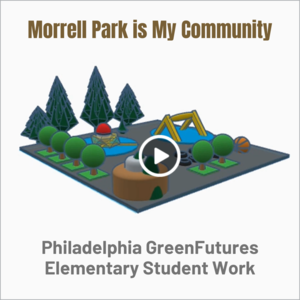
Morrell Park Is My Community GreenFutures Elementary Student Work
With support from GreenFutures, a program of the School District of Philadelphia (SDP), the Fairmount Water Works, the educational outreach arm of the Philadelphia Water Department, the Cloud Institute and a cohort of elementary faculty from the SDP developed and piloted two new Units of Study for the 4th and 5th grades to expand FWW’s 6-UNIT Middle School Curriculum (grades 6-8 ) Understanding the Urban Watershed Curriculum. These 4th Grade and 5th Grade Units provide an opportunity for upper elementary school teachers to connect their students to the community and to the environment outside of their classroom, and to one of the most fundamental elements of all living things-water. Together, teachers and students explore their role and responsibility to individually and collectively protect and sustain this shared resource for today, for tomorrow and for future generations.
Read More
Fall Newsletter | Useful Resources for Educators
Check out the Climate Change Education Resource Guide for Schools produced by the team at the Center for Sustainability and Climate Education at the Dutchess County BOCES. Find ideas, resources and activities to start the conversation about our climate and the actions that we, our students and colleagues can take as global citizens.
Read More
Sustainable Development Goals - Useful Resources
We don’t know too many schools and districts that are teaching about the Sustainable Development Goals (SDGs). The Sustainable Development Goals are a collection of 17 interlinked global goals designed to be a "blueprint to achieve a better and more sustainable future for all". The SDGs were set up in 2015 by the United Nations General Assembly and are intended to be achieved by the year 2030.
Read More
Living and Breathing Education for Sustainability (Podcast)
Living and Breathing Education for Sustainability - Sequoia Group Singapore EfS Podcast. In this podcast Jaimie discusses creating awareness, fostering commitment and guiding actions towards a healthy, secure and sustainable future.
Read More
The Hudson 7 + 'Sustainability' Arrives in the Classroom
Jaimie Cloud, of the Cloud Institute for Sustainable Education and Jenny Schinella of Dutchess BOCES join the Green Radio Hour with Jon Bowermaster to talk about just how important it is today to introduce 'sustainability' into every crevice of our education system. Click here to listen to the radio show
Read More
The Path Forward for Education and Climate Action Webinar
This is a great webinar that was hosted by the Center for Universal Education and Education International to discuss the path forward for education and climate action, and the recent Brookings policy brief “Unleashing the creativity of teachers and students to combat climate change: An opportunity for global leadership.”
Read More
Spring Newsletter | Play The New Fish Game Online and Summer PD for Educators
Thanks to all of you who supported the upgrade of The Fish Game Online and to the team at Funatomic - educational game developers extraordinaire. The new Fish Game is now live! There are many new features to play with, including the ability to choose the number of fisher folk with whom you are fishing in each game; the ability to announce your intentions or not, and the ability to do or not do what you promised. You’ll see that everything you do and don’t do makes a difference. Let us know what you think!!!
Read More
The Cloud Institute and The Sequoia Group in Singapore | The Green Plan 2030
Client Spotlight
We are excited to announce The Cloud Institute’s new long term collaboration and partnership with the Sustainability Institute at Sequoia Group in Singapore. “We have been planning this for eleven years” said Jaqueline Wong, Executive Director of Sequoia Group and Co-Director of the Sustainability Institute, about our new work together. “The conditions are finally favorable in Singapore for this to happen.” The Singapore Green Plan 2030 has launched and takes Education and Schools seriously as leverage points for sustainability.
Read More
Winter News | Education for Sustainability is Essential
The EfS Reservoir is a multi-media repository of exemplars aligned to the EfS Benchmarks. The exemplars include quality curriculum units, courses, assessments, performance criteria, student work samples and eventually stories, interviews, discussions, images, narration and film that will illustrate the contexts and the impact of this work in schools and communities. Register for free to access the collection.
Read More
Washed Ashore Artwork - Art To Save The Sea
Lessons in Ocean Stewardship, Sustainability, and Responsible Consumer Habits
Washed Ashore Artwork features giant sea life sculptures made entirely of marine debris collected from beaches to graphically illustrate the tragedy of plastic pollution in our ocean and waterways.
Since 2010, thousands of volunteers have worked together with the non-profit organization Washed Ashore under the guidance of Founder and Artistic Director Angela Haseltine Pozzi to create these powerful art pieces.
Read More
Connecting Diversity, Equity and Inclusion (DEI) and Educating for Sustainability (EfS)
What do Diversity, Equity & Inclusion (DEI) and Educating for Sustainability (EfS) have to do with one another?
Where are the “twofers”—the power standards that are rich enough to do both? What does it look like to deliver instruction that honors DEI and also prepares students to participate in, and lead with us, the shift toward a sustainable future? In this webinar, we explored these and other questions about the intersection of EfS and DEI and discussed unit exemplars that honor both.
Read More
Fall Newsletter | 25 Years of Educating for Sustainability
Twenty-five years of engaging educators and inspiring young people to think about the world, their relationship to it, and their ability to influence it in an entirely new way. In our opinion, there is nothing more important than learning and working together for the future we want. We believe that a healthy and sustainable future is possible.
Thank you to all who have participated in, and contributed to, this important work. Here’s to the next 25!
Read More